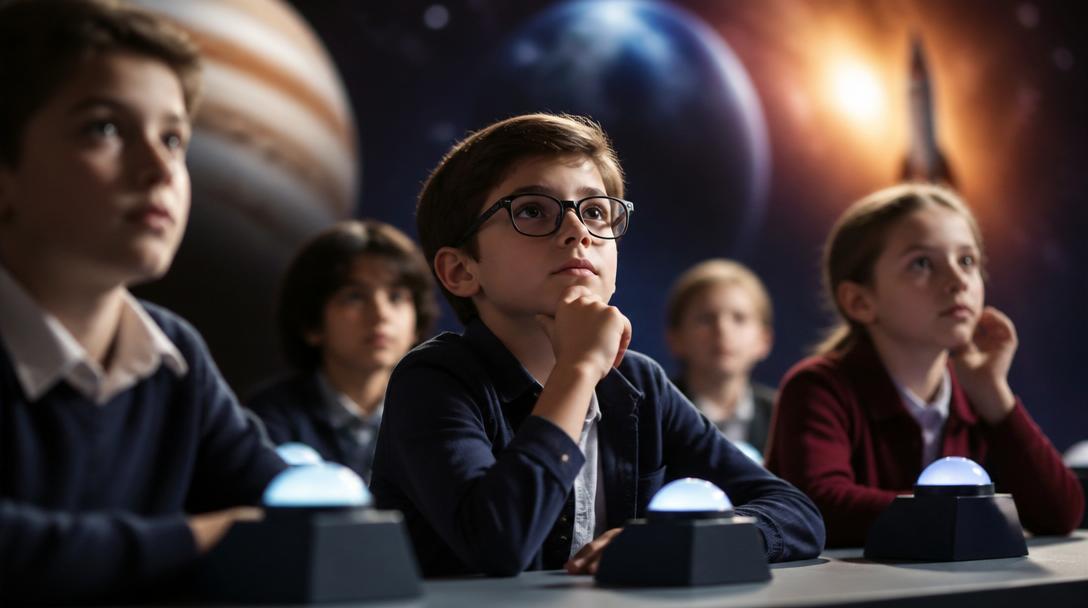
Space Quiz Challenges Clever Young Minds
For children who like a challenge, astronomy offers the perfect mix of facts, patterns and oddities. The planets are easy to name in order if you have practised, but the real fun begins when the questions move beyond simple recall and ask what makes each world different. That is where a clever kid can shine, because space is packed with details that are both scientific and surprising.
Earth is the obvious starting point, yet it is worth pausing on what makes it special. It is the only known planet with liquid water on its surface and the only world we know of that supports life, which gives children a strong reference point for comparing the rest of the Solar System. From there the contrast becomes sharper, because Venus is hotter than Mercury even though Mercury is closer to the Sun, thanks to its thick atmosphere trapping heat. Questions like that are ideal for a quiz, because they reward anyone who really understands rather than simply memorises.
Mars is another favourite because it feels familiar but remains very different from Earth. It has the largest volcano in the Solar System, Olympus Mons, and a giant canyon system called Valles Marineris, both of which help children grasp just how dramatic planetary geology can be. It also has two small moons, Phobos and Deimos, which are far less impressive than our own Moon but still useful for reminding young learners that not every planet follows the same pattern. A good quiz can use Mars to move from basic facts into the bigger idea that planets are shaped by gravity, atmosphere and time.
The outer planets bring another layer of wonder, especially because they are so unlike the rocky worlds nearer the Sun. Jupiter is the largest planet and is famous for its Great Red Spot, a storm that has raged for a very long time, while Saturn is loved for its bright rings, which are made mostly of ice and rock. Uranus and Neptune are often less familiar to children, which makes them perfect quiz material, since both are giant planets with very cold, windy atmospheres and a bluish appearance. Asking why Neptune looks blue or why Saturn has rings encourages children to think about light, composition and motion rather than treating the planets as simple names on a list.
Moons can be just as fascinating as the planets they circle. Jupiter’s moon Europa is thought to have a hidden ocean beneath its icy surface, and Saturn’s moon Titan has a thick atmosphere, which makes it one of the most interesting places in the Solar System. These are the sorts of facts that turn a space quiz into a proper adventure, because they show that the largest mysteries are not always on the biggest worlds. Children often enjoy the idea that some moons may be stranger than planets, especially when they learn that our own Moon has no air and no liquid water on the surface.
A strong astronomy quiz also works because it can stretch across different kinds of knowledge. Some questions are about sequence, such as placing the planets in order from the Sun, while others are about classification, such as separating rocky planets from gas giants and ice giants. There are also questions about what stars are, why the Sun is a star, and how light-years measure distance in space. Once children realise that the universe is not just a collection of facts but a set of connected ideas, the subject becomes much easier to enjoy.
The night sky adds another practical dimension, because children can often see what they are learning about. The Moon’s phases, bright planets like Jupiter and Saturn, and constellations visible in the British sky all help make astronomy feel real rather than remote. Even a simple look upwards on a clear evening can prompt good quiz questions, such as why the Moon appears to change shape or why some stars seem brighter than others. That immediate link between textbook knowledge and the sky above is one reason space remains such a strong topic for curious minds.
What makes this subject especially suited to clever kids is the way it rewards careful thought. A child who knows that Mercury has almost no atmosphere, that Venus is extremely hot, and that Mars is cold and dusty is already beginning to compare worlds rather than merely naming them. Add in the size of Jupiter, the rings of Saturn, the icy edges of the Solar System and the possibility of oceans under distant moons, and the quiz becomes a tour of the universe’s variety. It is a subject that invites questions at every turn, which is exactly why it keeps children coming back for more.