Marvel and DC Quiz Fun for Children
For many children, superheroes are the first big invitation into reading, films and comics, because the stories are bright, dramatic and easy to enjoy. Marvel and DC are the two best-known comic book universes, and each has created heroes who have become part of everyday culture. Spider-Man, Batman, Superman and the Avengers may live in different fictional worlds, but they all ask the same exciting question: what would you do if you had extraordinary powers or a brilliant suit of gadgets?
Marvel began in the United States in the 1930s under the name Timely Publications, before becoming Marvel Comics in the 1960s. DC Comics has an even longer history, going back to the late 1930s and the early adventures of Superman and Batman. These companies are famous for different styles, which is useful for quiz questions because children can learn to tell them apart. Marvel stories often focus on heroes who feel a bit like ordinary people with unusual problems, while DC is known for larger-than-life figures such as Superman, Wonder Woman and The Flash.
A good superhero quiz for children should start with the characters most people recognise straight away. Spider-Man is one of Marvel’s best-known heroes, created by Stan Lee and Steve Ditko, and he first appeared in Amazing Fantasy in 1962. Batman, created by Bob Kane and Bill Finger, made his first appearance in Detective Comics in 1939, while Superman, created by Jerry Siegel and Joe Shuster, first appeared in Action Comics in 1938. These details matter because they help children see that every hero has a proper comic book origin, not just a film or television version.
Children also love the supporting characters, because heroes rarely work alone. Marvel gives us Iron Man, Captain America, Black Widow and Thor, while DC offers Robin, Aquaman, Green Lantern and the Justice League. A quiz can ask which hero uses a shield, who lives in Gotham City, or who wields a hammer called Mjolnir. Those clues are fun because they reward careful listening and memory rather than pure guesswork.
Villains are just as important, and in some cases they are even more memorable than the heroes themselves. Marvel has enemies such as Loki, the Green Goblin and Doctor Octopus, while DC includes the Joker, Lex Luthor and Catwoman. Children often enjoy villain questions because the characters have such bold looks and dramatic plans. A well-made quiz can help young players learn that a hero’s world is shaped by the challenges they face, not only by their powers.
One of the best ways to keep a superhero quiz lively is to include powers, gadgets and secret identities. Peter Parker is Spider-Man, Bruce Wayne is Batman and Clark Kent is Superman, which gives children an extra clue to work with. Some heroes rely on super strength, others on intelligence, speed or technology, and that variety makes the subject rich for trivia. It also means children can answer questions even if they do not know every comic book detail, because they can think about what each hero does best.
The success of Marvel and DC on the big screen has made superhero knowledge even more popular among children. Marvel films helped turn characters like the Avengers into household names, while DC films and television shows have kept Batman and Superman at the centre of family viewing for decades. Yet the comics remain the real starting point, and that is worth remembering in a quiz. Knowing where a character first appeared, who created them and which universe they belong to gives the game a proper sense of history.
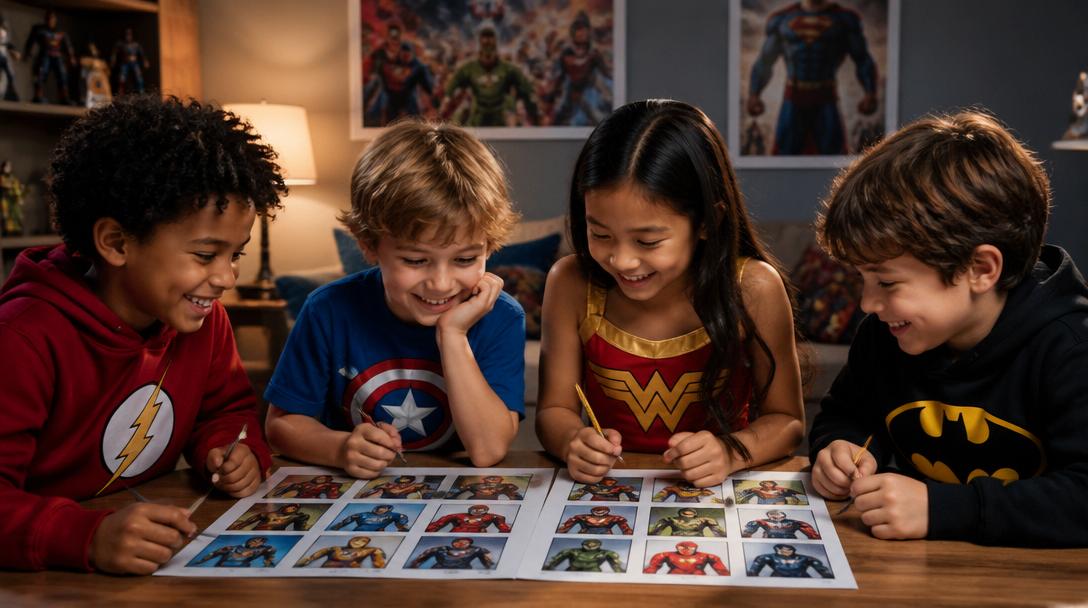
A superhero quiz can also be a gentle way to build reading confidence. Children often enjoy spotting patterns, remembering names and matching characters to their symbols, whether it is Batman’s bat signal, Spider-Man’s web-shooters or Wonder Woman’s lasso. The best questions feel like a game rather than a test, and that helps young fans stay interested from start to finish. When the subject is superheroes, learning can feel a lot like play, which is exactly why Marvel and DC continue to capture children’s imaginations so strongly.