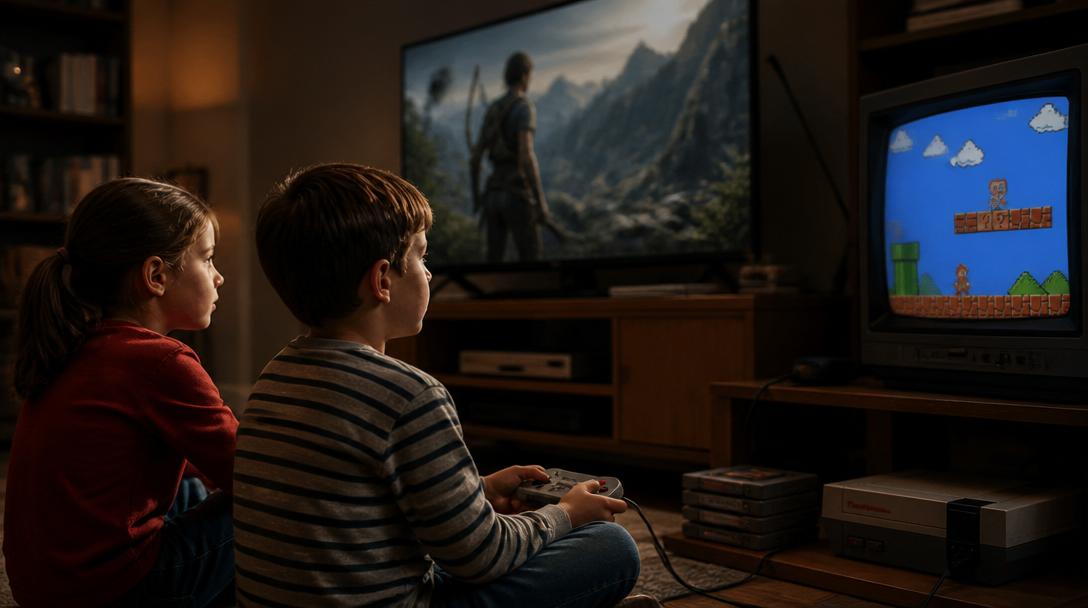
Retro and Modern Games Still Shape Play
The best gaming trivia questions do more than ask who starred in a famous franchise or which console arrived in which year. They reveal how the medium has evolved from coin-operated cabinets and living-room cartridges into a global culture shaped by online play, live updates and enormous development budgets. That makes retro and modern games an especially rich subject, because the two eras are not separate chapters so much as a long conversation across decades.
Retro gaming still exerts a powerful pull because so many of its landmarks are instantly recognisable. Pac-Man, released by Namco in 1980, remains one of the most famous arcade games ever made, while Tetris, created by Alexey Pajitnov in 1984, has become a byword for elegant design. Nintendo’s Super Mario Bros., released in 1985, helped define the side-scrolling platformer, and The Legend of Zelda, from 1986, gave players a sense of adventure and exploration that still shapes the genre today. These are not just old favourites for nostalgia’s sake; they are the roots of systems, styles and ideas that are still everywhere.
A good quiz on retro games often rewards players who remember the hardware as much as the software. The Nintendo Entertainment System arrived in Europe in the late 1980s and became a household name, while the Sega Mega Drive and Super Nintendo Entertainment System turned the early 1990s into a fierce console rivalry. In arcades, games such as Space Invaders and Donkey Kong helped turn video games into a public spectacle, with scores displayed for all to see and mastery measured in high-score tables. Even the sound of these games matters, because the simple melodies and effects were part of their identity long before orchestral scores became common.
Modern gaming trivia, by contrast, tends to focus on scale, connectivity and the way games now live beyond the moment of purchase. Minecraft, first released in 2011, became a phenomenon through creativity and sharing as much as through design, while Fortnite turned the battle royale format into a cultural fixture after its launch in 2017. Grand Theft Auto V, released in 2013, has remained one of the best-known games of the era, helped by its online component and the continuing popularity of its open world. Questions about modern games often stretch beyond the game itself to publishers, updates, downloadable content and the way a title can keep changing long after launch.
That shift has altered the sort of knowledge trivia players need. In earlier decades, the key details were often the year of release, the platform and the name of the protagonist. Today, it may also matter whether a game launched first on one system before appearing on another, or whether its online mode became the feature that kept it relevant. The rise of digital distribution has also changed how games are remembered, because some of the most talked-about titles never depended on boxed copies or shelf space in the first place.
The range of genres is another reason the subject works so well in quiz form. Retro gamers may be expected to know the difference between a platformer, a shoot ’em up and a role-playing game, while modern players are more likely to recognise battle royale, open world and sandbox design. Yet the boundaries blur quickly. The idea of collecting items, levelling up characters or exploring a vast map can be traced through both eras, showing how contemporary games often build on ideas that were already present when sprites were tiny and memory was scarce.
For many players, the appeal of a gaming trivia quiz lies in the way it mixes memory with recognition. One question might ask about the original arcade version of a classic, another about the latest entry in a long-running series. Someone who grew up with Sonic the Hedgehog may also know the latest FromSoftware or Nintendo release, because gaming culture encourages people to move between old and new without much fuss. That is part of what makes the subject so satisfying: it is not a sealed-off museum piece, but a living archive that keeps expanding.
There is also something democratic about gaming knowledge. You do not need to have played everything to join in, because a great deal of trivia comes from the shared language of culture, whether that means recognising a controller layout, a famous soundtrack or a character silhouette. A person who never mastered Street Fighter II may still know it was a defining arcade fighter of the 1990s, just as someone who never completed Elden Ring may still understand why it became such a talking point. Gaming trivia works best when it captures that overlap between personal experience and common reference.
What keeps the topic fresh is that games never stay still for long. A classic title can be reissued, remade or remastered, while a modern hit can become retro surprisingly quickly once enough years have passed. The result is a quiz subject that constantly renews itself, with each generation adding its own favourites to the same long list. That is why the real measure of a gaming fan is not simply whether they know the answers, but whether they can see the line connecting an arcade cabinet from 1980 to a sprawling online world released decades later.