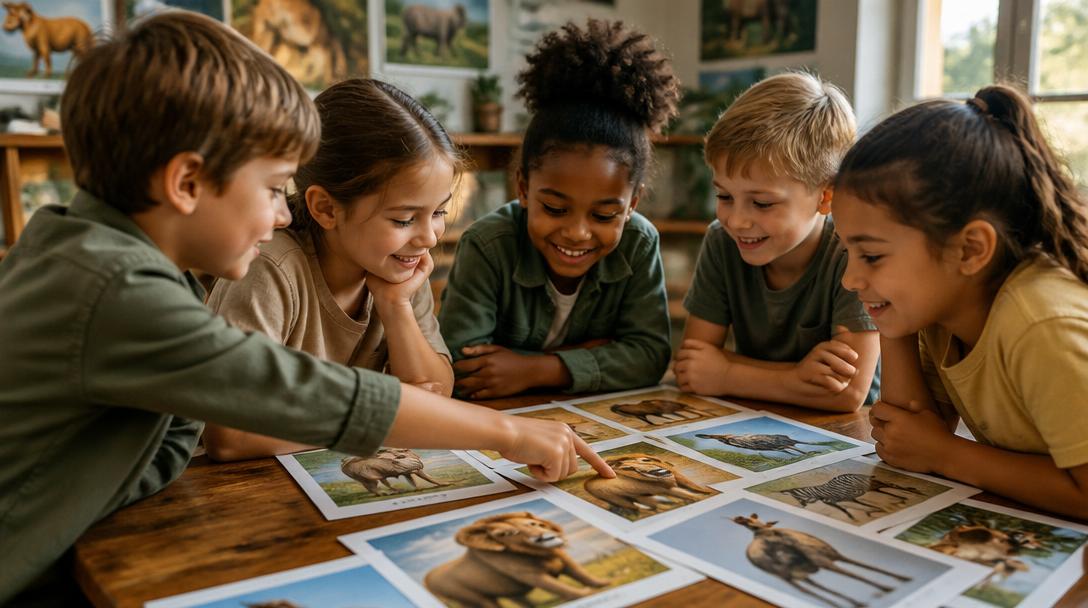
Wildlife Quiz Fun for Young Animal Fans
Children usually learn best when they are enjoying themselves, which is why a wildlife quiz can be such a powerful way to build knowledge. Ask a child to identify an animal from a clue about its habitat, its diet or the sound it makes, and the whole exercise becomes an adventure rather than a lesson. It is also a clever way to encourage close observation, because many creatures look similar at first glance but behave in very different ways.
The best quizzes begin with animals that children already know. A lion, a penguin, a dolphin or a fox gives them confidence, while a question about where each lives or what each eats helps them think beyond the obvious. A lion lives in the grasslands of Africa, not in the jungle, and penguins are birds that cannot fly but are superb swimmers. Facts like these are memorable because they challenge common assumptions and open the door to a broader understanding of the natural world.
From there, the quiz can move into more surprising territory. Children are often fascinated to learn that some animals are masters of disguise, such as stick insects that resemble twigs or chameleons that can change colour to blend in with their surroundings. Others are known for unusual adaptations, like camels storing fat in their humps or giraffes having the same number of neck bones as most other mammals, just much longer ones. These details make the animal kingdom feel wonderfully inventive, as though nature has been solving problems in every possible way.
Sound is another excellent theme because many animals are recognised as much by what they do as by how they look. Owls are famous for their quiet flight and sharp hearing, while bats use echolocation to navigate in the dark. Frogs, birds and wolves each have their own distinctive calls, and children often enjoy matching the right sound to the right creature. Questions like these can be especially effective because they invite children to imagine the animal rather than simply memorise a fact.
A strong wildlife quiz also introduces children to habitats, because animals are shaped by the places they live. Arctic foxes have thick fur and compact bodies to cope with cold conditions, while meerkats thrive in hot, dry environments and live in social groups. Seahorses are a good reminder that the sea holds its own astonishing variety, and that some species, including the male seahorse, have unusual parenting roles. Learning about habitats helps children understand that animals are not random collections of facts but living creatures adapted to specific environments.
The quiz can then branch out into behaviour, which is often the most entertaining part for young players. Honeybees work together in colonies, ants create organised societies, and elephants are known for their strong social bonds and long memories. Octopuses are particularly intriguing because they are highly intelligent invertebrates with remarkable problem-solving abilities and the ability to squeeze through small gaps. When children hear that animals can cooperate, hunt, hide, travel or communicate in such varied ways, they start to see wildlife as a set of fascinating strategies rather than just a list of species.
It is worth including a few questions that reward careful thinking rather than simple recall. For example, a child might be asked whether a whale is a fish or a mammal, or whether a snake has legs. These questions work well because they gently correct misunderstandings while still feeling playful. They also show that the natural world does not always fit neatly into the categories children first learn, which is an important part of scientific thinking.
Another way to make the quiz richer is to mix familiar animals with less familiar ones. Hedgehogs, badgers and robins may appear alongside koalas, armadillos or narwhals, giving children a glimpse of wildlife from different parts of the world. This can lead to conversations about conservation too, since many animals face threats from habitat loss, pollution or climate change. A quiz should not be gloomy, but it can plant the idea that wildlife is worth protecting because it is both extraordinary and vulnerable.
For children, the real pleasure of an animal quiz lies in the moment of surprise. They might know that a cheetah is fast, but not that its speed is matched by a body built for short bursts rather than long chases. They might recognise a squirrel, but not realise how important it is in spreading seeds. Each answer adds another layer to their understanding, and that sense of discovery is what keeps them coming back for more.
The most successful quizzes leave children feeling clever, curious and eager to learn the next thing. That is why wildlife questions work so well: they are rooted in real facts, full of visual appeal and endlessly varied. Whether the subject is feathers, fur, fins or footprints, the animal kingdom offers enough wonder to keep young minds busy for a very long time.