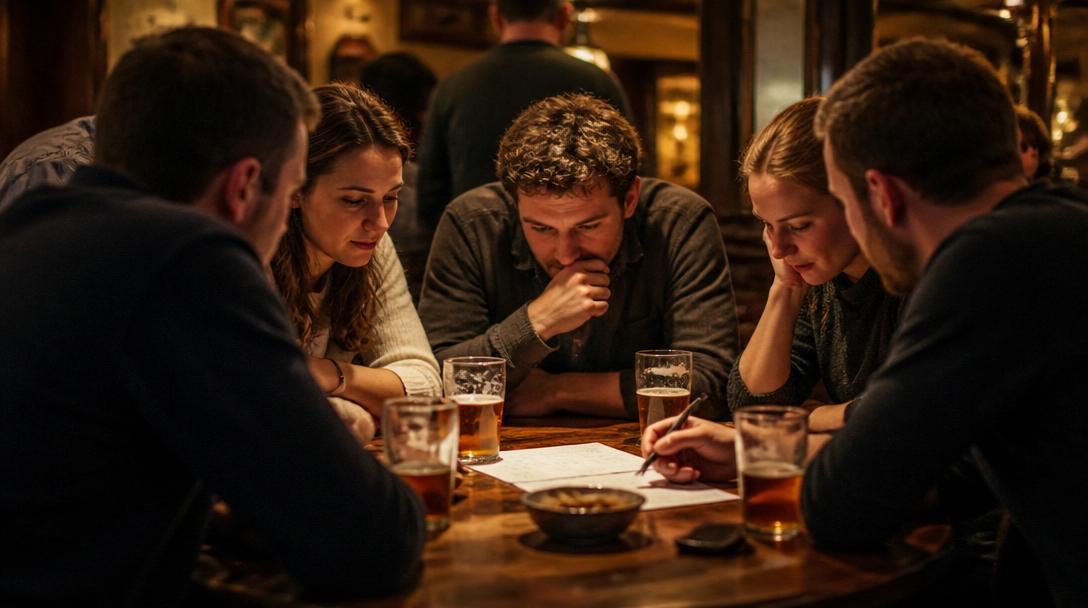
The Art of the British Pub Quiz
The British pub quiz has become one of the country’s most enduring forms of communal entertainment because it asks very little and gives back a great deal. A pen, a table and a team of friends are enough to turn an ordinary evening into a contest of memory, instinct and social chemistry. The appeal is not simply that people like winning, though they certainly do, but that the format allows everyone to contribute something useful, from a specialist interest to a lucky hunch. In that sense, the quiz is a rare public game in which knowledge, personality and timing all matter at once.
Its modern shape is closely tied to the pub itself, a setting that has long served as a meeting place rather than merely a place to drink. The quiz works because it fits the rhythm of the pub night: it can begin after work, run alongside conversation and draw people into a shared task without demanding silence or formality. Unlike a television quiz, where a contestant faces the pressure alone, the pub version rewards collaboration and the kind of collective recall that often seems to improve after the first round. One person remembers a film title, another knows a capital city, and a third has an unexpectedly sharp ear for a song lyric.
Part of the magic lies in the questions themselves. A strong quiz mixes subjects so that no single speciality dominates, and the best setters understand that pace matters as much as difficulty. If the rounds lean too heavily on obscure facts, the mood sours; if they are too easy, the whole thing feels flat. The sweet spot is a sequence that lets teams build confidence, then shakes it a little, whether with a picture round, a general knowledge section or an unexpectedly awkward question about sport, history or current affairs. The tension between certainty and guesswork is exactly what keeps people leaning over the table and arguing in low voices.
British pub quizzing also thrives on its local character. Some pubs favour a cheerful, old-fashioned style in which the quizmaster reads from paper and the scoreboard is updated by hand. Others have embraced picture rounds projected on a screen or themed evenings built around films, music or a particular decade. Yet the essentials remain stubbornly consistent: teams gather, answers are scribbled down, and the room slowly divides between the confident and the anxious. Even the rituals of complaint are part of the fun, from accusations that a question was unfairly worded to the familiar claim that the answer was “obvious” only in hindsight.
The strongest quizzes do more than reward the best-informed team. They create an atmosphere in which the whole room feels involved, because everyone is listening to the same clues and sharing the same suspense. A good quizmaster understands timing, clarity and fairness, but also performance, because the delivery of a question can be as important as the answer. A pause before the reveal, a wry tone or a carefully chosen follow-up can lift an ordinary round into something memorable. The room begins to feel less like a competition and more like a performance with audience participation.
There is also a distinctly British pleasure in the social balance the pub quiz produces. It is competitive, but only up to a point; serious enough to matter, but informal enough to forgive mistakes. People who might never join a sports team or a club can still take part, and mixed groups often work best because they combine different kinds of knowledge and different temperaments. The result is an evening where a retired engineer, a student, a teacher and a casual drinker can all have something to offer, which is one reason the format remains so resilient.
Technology has changed some details without altering the core experience. Questions may now be delivered through apps or projected onto screens, and teams often record answers on digital devices rather than paper. Yet the atmosphere still depends on the same simple ingredients: anticipation, shared effort and the satisfying moment when a team realises it has been right all along. In a culture where entertainment is often solitary and screen-based, the pub quiz endures because it remains gloriously local, mildly chaotic and unmistakably human.