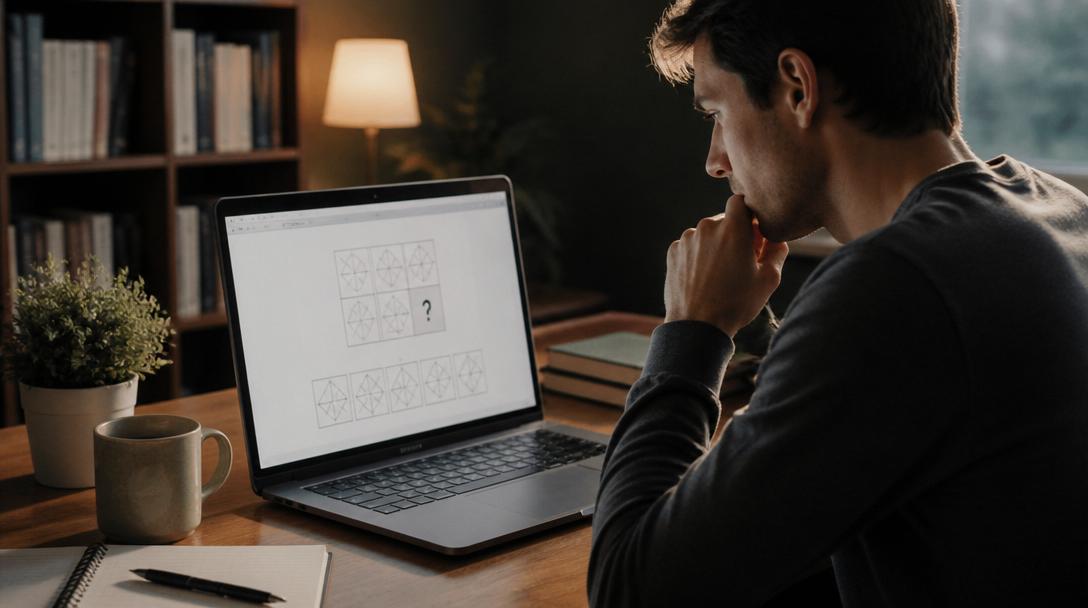
How Free IQ Tests Really Work Online
The appeal is obvious. In a few minutes, with no appointment and no fee, you can answer a string of questions and be given a score that looks impressively precise. That score may be good for a bit of fun, and it can even nudge you to think about the sort of thinking the questions reward. But it should not be mistaken for a clinical measurement of intelligence, because a true IQ assessment is a carefully controlled process carried out by trained professionals.
Online quizzes often borrow the language of psychology, yet they usually measure only a narrow slice of ability. A standard IQ test in a formal setting is designed to compare a person’s performance with that of a large reference group, using tasks that probe verbal understanding, working memory, processing speed and non-verbal reasoning. Many free versions online focus mainly on puzzles, sequences or visual patterns, because those are easy to present on a screen and easy to score automatically. That makes them accessible, but it also means they can only ever hint at the broader picture.
The biggest difference is consistency. In a proper test, the conditions are controlled so that the result can be interpreted fairly, whether the person is sitting in a clinic, an educational setting or another supervised environment. Online tests can vary wildly in length, difficulty and quality, and some are built more for entertainment than accuracy. Even the same person may receive different scores on different websites, simply because the questions, scoring methods and timing rules are not the same.
That does not make them worthless. A well-made free IQ test online can be a useful warm-up for the kind of thinking that crops up in formal reasoning tasks. Spotting a pattern in shapes, continuing a number sequence or identifying an odd item out all call on concentration and flexible thinking. For many people, that is enough reason to have a go, especially if they enjoy logic puzzles and want a quick mental challenge during a lunch break or a commute.
It is worth keeping expectations in check. A score from a website should be treated as a rough indicator, not a verdict on intelligence, potential or character. Intelligence is broader than any single number, and it is shaped by education, experience, language, confidence and even how rested you are on the day. Someone who performs poorly on a hurried online quiz may still excel in practical problem-solving, creativity, leadership or spatial awareness.
The format can also influence the result. Some online tests are timed, which can penalise people who prefer to think carefully rather than quickly. Others use verbal questions that may suit native speakers more than those who are fluent in English but less familiar with idiomatic phrasing. There are also tests with very small question sets, which means a single careless mistake can skew the final score far more than it would in a more comprehensive assessment.
If you do try one, it helps to approach it as a snapshot rather than a diagnosis. Choose a site that explains what sort of questions it uses and how the score is calculated, and be wary of pages that promise dramatic certainty or use the result to push you towards a payment at the end. A sensible quiz should make clear that the figure is only approximate and that it is not a substitute for professional testing.
There is also a wider reason these quizzes remain popular. People are naturally curious about how their minds work, and a short online test gives that curiosity a neat, immediate outlet. It can spark a conversation, reveal strengths in certain kinds of reasoning and, at the very least, provide a brisk mental stretch. The best way to use it is the simplest one: enjoy the quiz, note the score, and remember that no online number can capture the full range of what a person knows, learns and can do.