Can You Spot These Famous Landmarks
The thrill of landmark trivia is that recognition often arrives before explanation. A single silhouette, a particular dome or tower, or even the shape of a bridge can trigger instant certainty, but the real pleasure comes from asking why it was built, what it has witnessed and how it came to stand for a whole city or nation.
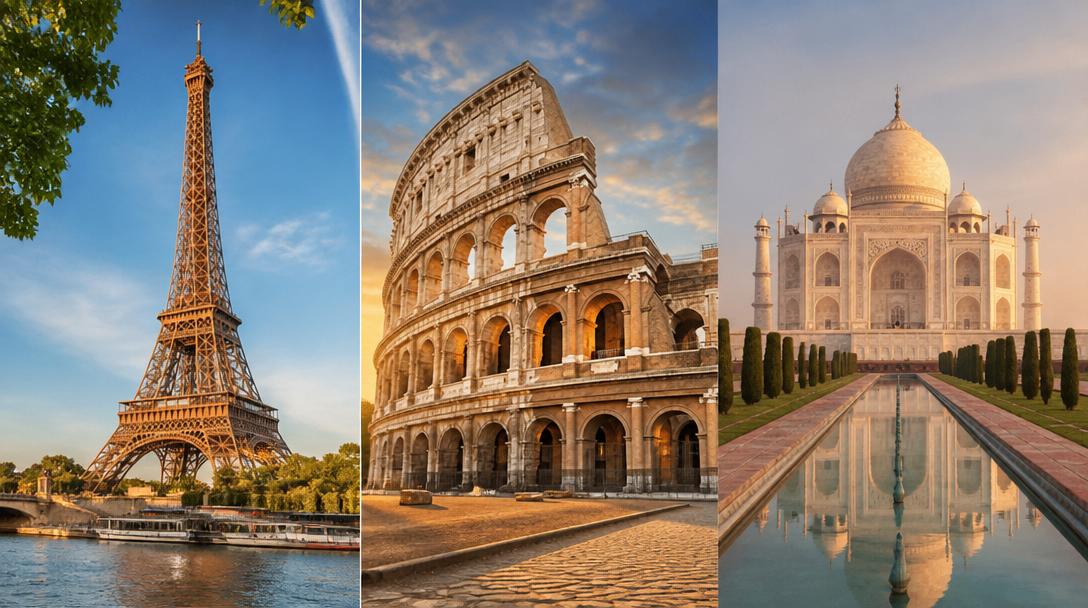
Take the Eiffel Tower, perhaps the most instantly recognisable structure in Europe. It was built for the Exposition Universelle of 1889 and designed by Gustave Eiffel’s company, but at the time many Parisians disliked it intensely and saw it as a temporary eyesore. That reaction feels almost comic now, given how thoroughly the tower has become part of the city’s identity, from its iron latticework to the nightly sparkle that draws visitors by the thousands.
A different kind of fame attaches to the Taj Mahal in Agra, where symmetry and white marble create one of the world’s most enduring images of devotion. It was commissioned by the Mughal emperor Shah Jahan in memory of his wife Mumtaz Mahal, and its refined gardens, calligraphy and inlaid stonework make it a masterpiece of Indo-Islamic architecture. People often talk about it as if it were simply beautiful, but its fame also rests on the emotional force of the story behind it.
In Rome, the Colosseum carries a very different mood altogether. This vast amphitheatre, completed in the first century AD, was the stage for gladiatorial contests and public spectacles, and its ruined arches still speak of imperial grandeur as well as brutality. It is one of those landmarks that seems to summarise an entire civilisation in a single glance, which is why it appears so often in quizzes and travel books alike.
London offers another familiar outline in the shape of Tower Bridge, which is often mistaken by visitors for London Bridge itself. Opened in 1894, it combines a bascule bridge with twin towers in a style that has made it one of the capital’s best-loved sights. Its popularity shows how a landmark can become famous not merely for age, but for the way it balances practical engineering with theatrical design.
Across the Atlantic, the Statue of Liberty has long served as a shorthand for welcome and aspiration. A gift from France to the United States, it was dedicated in 1886 and stands on Liberty Island in New York Harbour, where its torch and crown are known around the world. The statue’s meaning has grown over time, shaped by immigration, politics and popular culture, so that it now represents far more than the occasion for which it was first created.
Some landmarks are recognisable because they are deliberately monumental, while others endure because they seem to belong to the landscape itself. Machu Picchu in Peru is one such place, an Inca site high in the Andes that remained largely unknown to the outside world until the early twentieth century brought it wider attention. Its terraces, stone buildings and mountain setting have made it one of the most striking archaeological sites on earth, though its original purpose is still studied and debated.
Then there is the Great Wall of China, which is often imagined as a single unbroken structure but is in fact a series of walls and fortifications built over many centuries. Different dynasties contributed to its expansion and reinforcement, and the sections most tourists know today include later Ming-era work. Its scale is part of the attraction, but so is the fact that it reflects centuries of strategic thinking rather than one moment of construction.
The Sydney Opera House is another landmark whose fame comes as much from design as from function. Completed in 1973 after an often difficult and lengthy building process, it was designed by Jørn Utzon and is now one of the clearest examples of modern architecture becoming instantly symbolic. Its sail-like roofs make it easy to identify even in a quick quiz round, yet they also remind us that landmarks can be modern and iconic without needing to be ancient.
Travelling through trivia in this way reveals that famous places are rarely famous for just one reason. Some are admired for beauty, some for scale, some for history and some for the stories people attach to them afterwards. The best quizzes do not simply ask whether you can name the landmark from a photograph; they invite you to see how each place has earned its place in the world’s imagination.